Our office will be closed from 23rd December 2025 to 1st January 2025 in observance of the holidays. Regular business hours will resume on Monday, 5th January 2026. To ensure timely processing, please submit your orders by close of business on 8th December 2025, allowing us to accommodate shipping and lead times. For urgent matters during this time, please contact us HERE.
This summer, we asked for your most memorable fieldwork fails and funny stories, and boy, did you deliver! We gagged, we gasped, we guffawed—and we were touched. Here, we gleefully share our top five picks.
(And because there were too many good ones not to share, we will be rolling out a series of stories over the coming months. Get ready to be entertained!)
**2025 WINNER** Moth Whispers
By Luce Roux
Heat and humidity. Of all the tropical forests I had visited before, my first experience in the Amazon Rainforest was the most intense. I had just arrived after a long journey to a remote reserve to volunteer in the discovery of new species of moths. It was my first research experience before I embarked on bioacoustics.
Deep inside the forest, we were standing in front of what is commonly called a "light trap": a hot and powerful mercury bulb illuminating a large piece of white cloth. Within a few hours, hundreds of insects—moths, flies, mosquitoes, cicadas, wasps—would swarm the bulb and cling to linen.
The researcher, Gabriel, introduced visitors to the project and helped identify interesting specimens, inviting them to "collect" the insects. Pressing a glass jar against the cloth, he left just enough space for a moth to enter, and then quickly closed the lid.
The activity would take place every evening. "Thanks to a substance in the jar, the moth will fall asleep," Gabriel explained. He would usually pause until the entire group was paying full attention. In a dramatic voice, he would then add, "...forever!" Research is not for the faint-hearted.
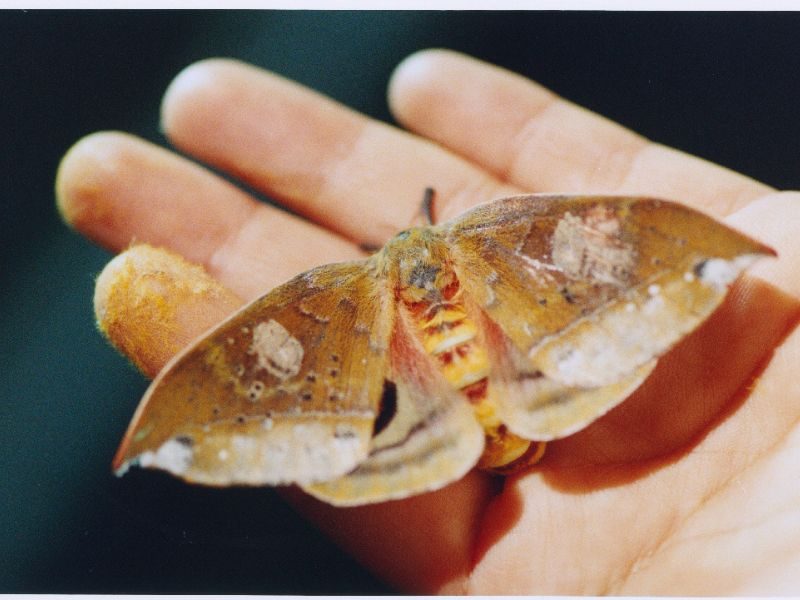
Following the instructions, I did my duty and captured a large orange-and-brown moth from the Saturniidae family. That night, while I slept, I was haunted by a terrible dream: I saw myself crushing the moth with my bare hand.
The dream was so vivid that I still felt it the next day. The following evening, I announced that I would help the project in any other way possible, but I would not "collect" moths. Luckily, for me, the project had a whole lot of other things that needed to be done.
For two months, I lived in the Amazon Rainforest and trained in spotting rare families of moths. I squinted my eyes, dazzling myself with the sun-like bulb, hoping to spot a subtle difference on a moth wing that could help preserve this ecosystem. I did not kill moths; instead, I pointed at the ones others should catch.
The next day, entomology expert Juan Grados would look through our samples. If he suspected any specimen to be a new species, I would take a sample—the bottom-right leg, which is the biggest—and place it in alcohol with the smallest label in the smallest glass tube. Once full, we would ship boxes of legs by boat to the nearest town, where they were mailed to Canada for DNA testing. We were particularly attentive to the "Tortricidae" family of moths, an elegant bell-shaped specimen with stripes on the tip of its wings.
Some moths were too delicate to travel and needed to be mounted for display onsite at the Natural History Museum of Lima. The "microlepidoptera" (or "micro moths") are only a few millimetres long. We would use the smallest pins—and a hefty dose of patience—to open their wings and reveal hidden patterns. Failing at this delicate job was incredibly frustrating: these moths were not mere specimens. We had chosen and collected them, and we owed it to them to make them beautiful to museum standards.
Time flew until my very last day.
For goodbye drinks, we would usually meet at the lodge bar. But for me, my friend Tamia pointed towards the forest: "We're meeting at the light trap!"
How exciting! It was after work hours, and we walked side-by-side with our flashlights, counting dozens of deadly Wandering Spiders on our path. Finally, we reached the clearing bordering the Madre de Dios River.
There they were: All my friends—researchers, volunteers, and staff—around a dazzling lemon meringue pie made by the chef. I grew emotional. The boat would bring groceries only once a week, and every single staff member, no matter their position, would form a line and carry the heavy packages through the slippery, muddy banks to the forest. So many eggs would break in the process; I knew how valuable they were.
Back to the cake: I don't remember if I ever had a piece of it. A friend was giving a goodbye speech when I suddenly started giggling uncontrollably. My ear was tickling. Then it stopped. It started buzzing. More giggles.
I leaned forward and shook my head. "I think I have something in my ear, and it doesn't seem to be coming out." The researcher quickly turned to a volunteer and said, "Run to the research centre and get my tweezers—now!"
"Naaaaah, not the tweezers," I thought to myself. These are destined to mount the micro-moths in display and are extremely pointy—nothing like your classic eyebrow tweezers. Needless to say, I was NOT happy to imagine these close to my eardrum.
I considered my options: We were isolated at night in a protected reserve of the Amazon Rainforest, accessible only by river, with no villages or communities nearby and no hospital. In less than half an hour, the electricity of the entire base would shut down. I would have to trust the PhD entomologist and his years of experience using these tools.
Rapidly, the tickling changed to pain. I lay down on my side, on the bench facing the light trap. "Luce, do not move at all," Gabriel said. I could feel his anxiety. Have you ever tried to stay still with a marching band turning on and off in your head?
After several hesitant attempts, he finally pulled it out of my ear. "Luce! It's huuuuuge!" he exclaimed. It was not huge, but it was far from small either. I had expected an ant, a mosquito, or one of the "micro-moths" we were studying—but not a 1.5-centimeter-wide moth.
There was a moment of silence and awe. Seeing all my friends, with their mouths wide open and big, round eyes, gathered around the tweezers of victory holding a unique moth, it felt like a scene from a Miyazaki anime.
Suddenly, the marching band in my ear started buzzing again. "Wait, wait," I said, "I think there's another one." And with that last sentence, the power shut down, and we were pitched into darkness.
We headed back to the research centre, with me walking funny, as my balance was off.
I placed myself under the general manager's office light—the only one still working at this hour—and Gabriel started foraging in my sore ear again. "This is so unlikely. They must have been mating and entered your ear by accident," said Gabriel. Excellent.
After what seemed to be an eternity, he finally took out the second moth. Ignoring the very late hour, he shouted, "TORTRICIDAE!!" (Yes—the family we had been looking for; a potential new species.) He laughed. Turns out, I did collect moths in the end.
The team always knew it was a potential risk. But strangely, in three years of doing this activity every single night in three different locations, with dozens of visitors, they had never seen someone catch a moth in their ear. And never ever had they seen someone catch two moths in their ear.
This was my epic last night in the Amazon Rainforest. I packed my luggage in complete darkness and left at sunrise. From the boat, I could see the team on the dock, waving goodbye. I left behind me the tale of a woman who once had two moths in her ear. I promised myself I would come back.
Tapeworm Face Slap
By Andrew Bruce
Years ago, I was working as a wildlife technician on a rabies research project, which involved trapping raccoons, chemically immobilizing them, and collecting blood samples, all from the glamorous setting of a truck tailgate.
One hot summer day, my colleague and I had just sedated a particularly hefty raccoon. As we worked, I noticed what looked like a long strip of white plastic lying next to the animal. Probably a torn glove or a bit of a sample bag, I thought. Not unusual. I absentmindedly set my gloved hand down on it and carried on.
Enter: the deer fly.
If you’ve ever worked outside in Ontario in July, you know the kind: those massive, bloodthirsty, buzzing psychopaths that show up uninvited and head straight for your face. One landed on my cheek, and instinct kicked in—I slapped myself with full force using my left hand, the same one that had just pressed on the “mystery strip.”
The fly was gone. Victory!
But something was...wrong.
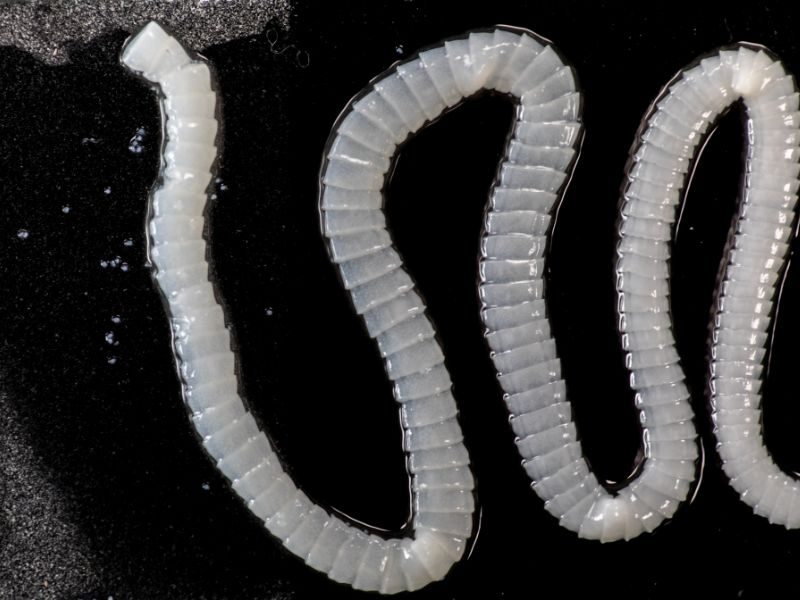
I felt a sticky sensation, followed by a slow, cold dread creeping across my face. My colleague stared at me, eyes wide, frozen in horror. I followed her gaze to my glove, then to the white strip now dangling across my cheek, and still connected to the raccoon’s butt.
It wasn’t plastic.
It was a tapeworm.
At least three feet of it had oozed out, thanks to my helpful hand placement and perfectly executed slap. And now, there it was, gracefully draped across my face like some parasitic fashion accessory.
I consider myself pretty tough. Blood, poop, biting mammals—I can handle it. But this? This was different. This was a line crossed. I spent the rest of the day gagging silently and reevaluating my entire career. Data entry suddenly seemed noble. Maybe even heroic.
Instant Noodles and Red Briefs
A Tale of Endurance in Leuser National Park's Untamed Heartland
By Tedi Wahyudi
September 2009.
The morning haze slowly dissolved, revealing the commanding heights of hills nestled deep within Leuser National Park. After nearly twenty days of confronting incessant monsoons, wickedly sharp rattan barbs, and a wilderness that had never extended hospitality to researchers pursuing rhinoceros conservation data.
That day, the sun blazed with remarkable intensity, as if offering an unparalleled gift of warmth and profound peace. For us, that morning seemed like an extraordinary luxury bestowed by divine providence.
We chose to delay our journey for a while. We wanted to embrace the tender warmth of sunlight and feel genuinely alive without being enslaved by urgency.
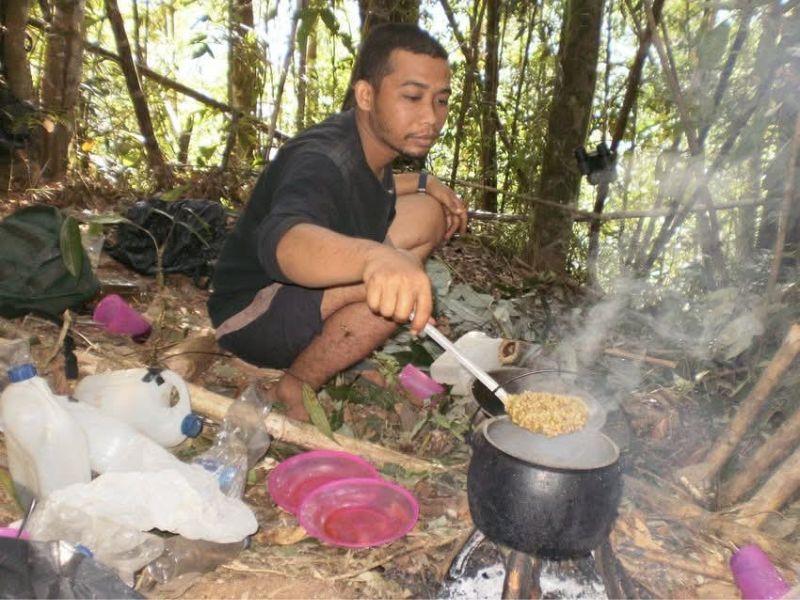
While each team member engaged in their respective tasks, one friend patiently busied himself preparing instant noodles over a makeshift fire stove. The rich aroma crept into the air, tempting stomachs that had been sustained on emergency provisions for far too long. Several other team members were hanging out soaked clothing, souvenirs from yesterday's unrelenting rainfall. As for me, I chose to stroll a little distance away, watching birds around the camp and hunting for the green pigeon nest I had spotted the previous day.
During my activities, I witnessed something bizarre about a teammate's behaviour: they started setting up small stakes around the cooking stove. At first, I thought it was just an ingenious way to support the cooking pot. But then my eyes bulged when I realized these little stakes were designated for drying red briefs—briefs that had been adhered to his body for nearly twenty days. Briefs that remained constantly wet and clammy. Briefs that stored almost twenty days of body and forest odors that nobody would ever want to smell.
With conflicted feelings swirling inside me, I approached him. In a half-protesting voice, I warned him, "Hey, your briefs might drop into the noodles."
He turned with a casual expression, fanning the fire with a plastic plate without any sense of guilt, and answered, "Relax, it's strong enough. I just want to wear dry briefs today."
After a “brief” dispute, feeling somewhat annoyed, I exhaled deeply, shrugged, and walked away. In my thoughts, I said to myself, "Well, everyone has their own way of surviving in the wilderness," and continued my activities.
Suddenly, ten minutes later, a scream pierced the hillside silence.
"AAAHHH! BLOODY HELL!"
Shocked, I ran as fast as my legs would carry me. My heart hammered frantically; dire thoughts flooded my mind. I feared something terrible had happened to my teammate—we were in the territory of vicious Sumatran tigers. I raced to the stove where my friends had gathered.
And there, in front of the fire stove, I saw a tragedy I never wanted to witness in my lifetime. The briefs—those red briefs—had dropped into the pot. Not just dropped, but plunged completely into the pot of boiling instant noodles.
We all stood speechless. There were no words. Only blank stares at the pot, as if what was boiling inside wasn't just noodles but our hope for a decent breakfast.
After being shocked for several moments, I finally spoke with a heavy and bitter voice mixed with emotion.
"I already told you it would fall into the pot," my voice slightly snapping. "Just throw those noodles away."
But another voice, quiet yet firm, replied, "If we throw them away, we'll run short of food. This journey still has another week to go."
Silence returned, our minds churning. We looked at each other, as if choosing between dignity and our stomachs. The discussion continued fiercely, full of doubt and calculation. Until finally, with resignation and heavy hearts, we made a decision that could probably only be understood by people who had lived too long in the jungle's embrace. Those noodles still had to be eaten.
And eventually, we ate them. One spoonful, then the next. The salty, savory taste mixed with dark shadows of those unfortunate red briefs. Every sip of broth was a battle between logic and survival needs. Until finally, the pot was empty. Gone, down to the last drop of soup.
Then suddenly, out of nowhere, our laughter burst forth. Loud, free, almost crazy laughter. The laughter of people who had lived too long under jungle pressure, laughter that could only be born from life's own absurdity.
That day, we didn't just eat instant noodles. We swallowed the reality that in the wilderness, even something disgusting could become a lifesaver.
And the story of those red briefs will always live as a legend of the Rhino Team's journeys, conducting rhinoceros surveys in the depths of Leuser National Park.
Noodling For Sewer Frogs
By Seth Bunnell
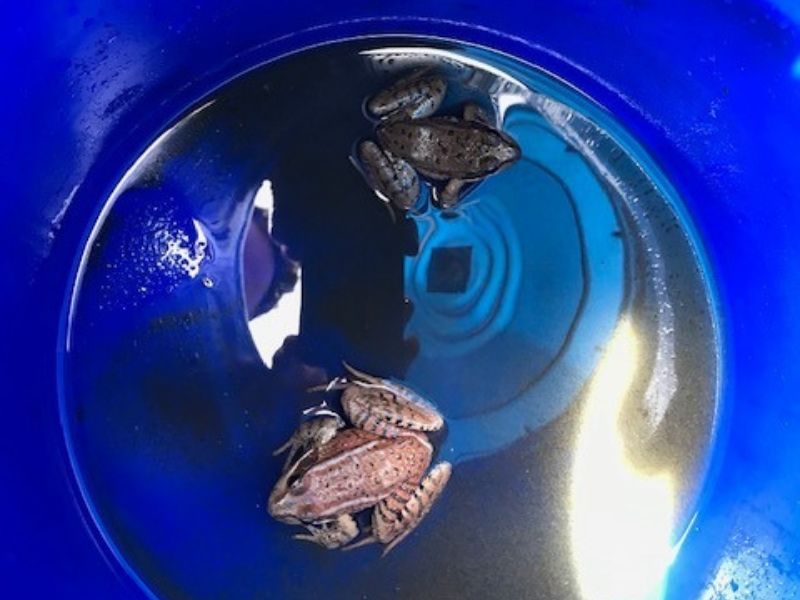
My grossest job was rescuing California Red-legged Frogs and a Western Pond Turtle from a concentrated slurry of raw sewage at Point Reyes National Seashore.
At first, the frogs would escape me by leaping from the steep bank into the deep toilet water where my net could not reach. As a crew of sewage roughnecks pumped out green-brown water, the frogs became more accessible. It became difficult to differentiate pairs of frog eyes from the many gas bubbles that accumulated on the slimy surface.
At one point, I had left my bucket, net, and gloves back on the levee. I was observing some partially digested food items when I spotted movement in the muck. Although gloveless and germaphobic, I made my move and grabbed the frog. The sewage felt warm and gelatinous all over my hand and forearm.
A rite of passage for a disease-fearing biologist with anxiety disorders.
A Battle of Wits with Bovines
By Darrian Washinger
You never know what you're going to run into when deploying your acoustic equipment. I've run into a mama bear running towards her crying cub (scary moment), rattlesnakes, raccoons peaking out from behind trees, etc. You come to accept these run-ins as the norm. But one animal encounter I did not see coming was a battle with an unexpected contender.
There was one site where we set up some acoustic equipment, but when we checked it several days later, the pole was lying on the ground, and thus our survey was compromised. So we deployed it again, making it more secure for whatever curious creature was sabotaging our efforts—bear, deer, raccoon, who knew.
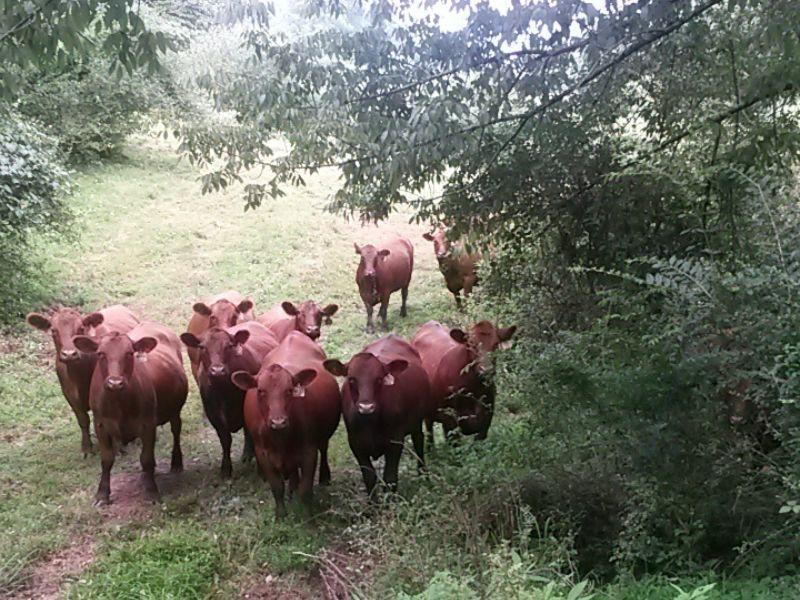
When we returned several days later, the equipment was down...again! Now we meant business and worked diligently to secure the equipment thoroughly. Sometime during set up, we turned around to find our contender watching our strategy from a few yards away, and they weren't alone.
Somehow, a herd of cows had snuck up on us and were watching the whole process! We had to laugh. How do several 1,000-pound bovines sneak up on us? And how did these cattle consistently thwart us?
Never fear: on our third attempt, we finally got some acoustic data without knocked down poles.
Vote for Your Favorite!
In the words of The Gladiator: "Are you not entertained?!"
Think you know which storyteller should win? Head over to Bluesky to cast your vote by 9/30/25!
In the spirit of reconciliation, Faunatech acknowledges the Traditional Custodians of Country throughout Australia and their connections to land, sea and community. We pay our respect to Elders past and present and extend that respect to all Aboriginal and Torres Strait Islander peoples today.
Join our mailing list to get notified about upcoming training opportunities, live webinars, quarterly grant offerings, product releases, and more.
Thank you for signing up to our mailing list.
You can unsubscribe or change your email settings at any time by clicking "Manage Preferences" link at the bottom of any mailing list emails we send you.
