Listening for Frogs: Bioacoustics, Country, and Collaborative Conservation
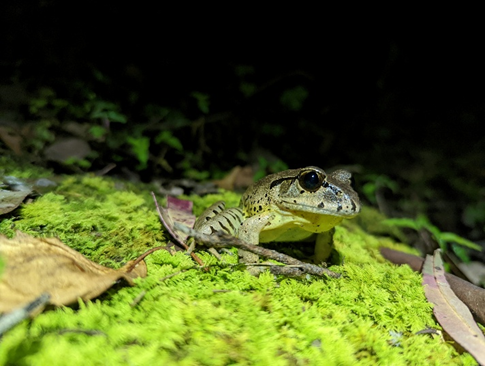
Mixophyes fleayi - pic: Coen Hird
Problem:
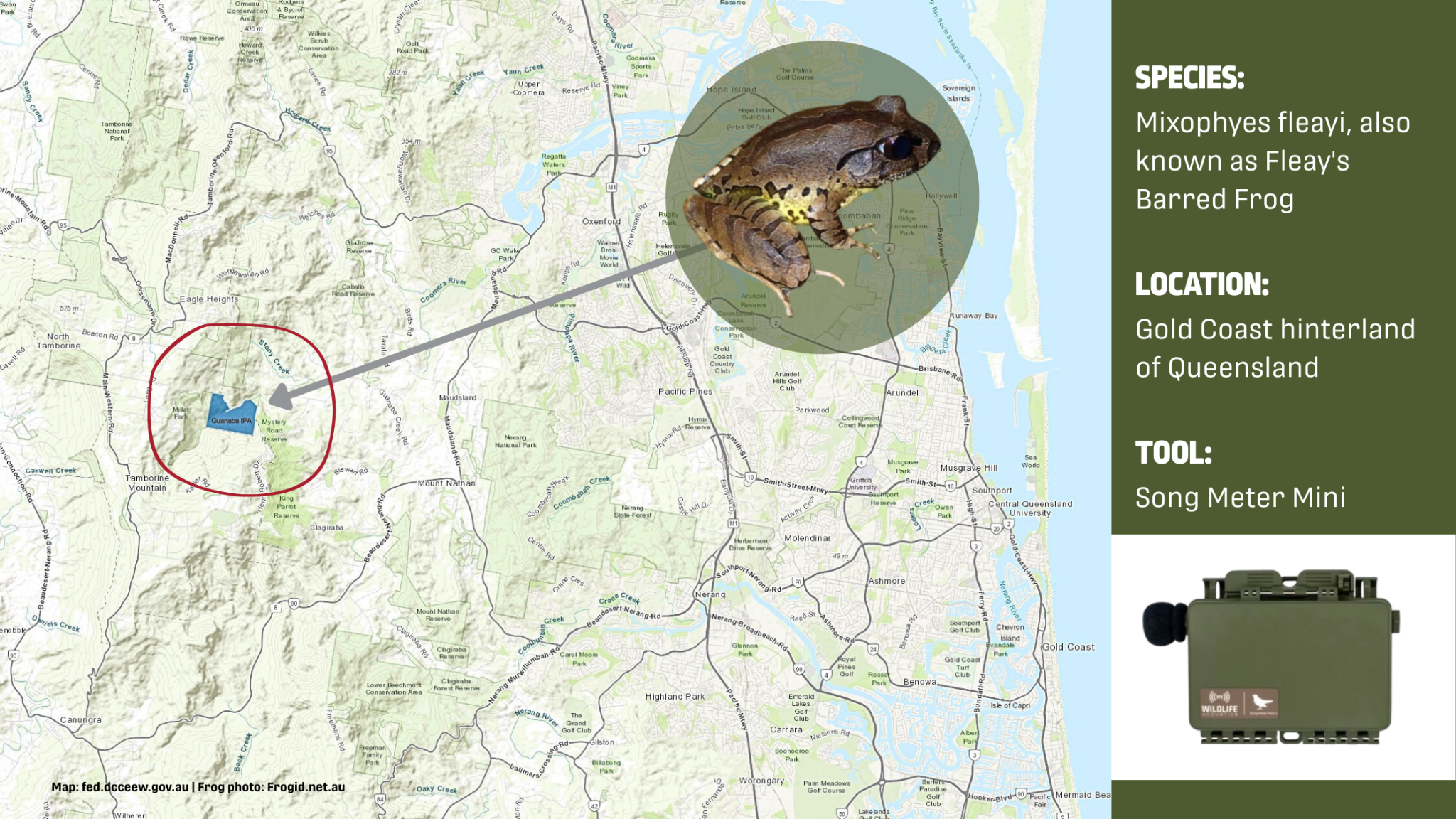
Monitoring threatened frogs in Guanaba Indigenous Protected Area (GIPA) - a 100-hectare Kombumerri-managed site in the Gold Coast hinterland of Queensland, characterised by dense rainforest, eucalypt woodlands and steep creek systems - relied on short listening windows and physically demanding surveys, limiting detection confidence for elusive species like Mixophyes fleayi.
Also called Fleay's Barred Frog, it has declined severely due to the amphibian chytrid fungus and is threatened by damage to its habitat from feral animals and urban development.
Solution:
Researchers partnered with Kombumerri Rangers, and introduced passive bioacoustic monitoring. This enabled continuous, non-invasive sampling across remote habitats while building local capability.
Outcome:
M. fleayi was not detected. But recordings improved understanding of detectability and unexpectedly captured Litoria chloris (red-eyed tree frog) - a species unrecorded in the area historically.
Researcher Bio
Coen Hird is an interdisciplinary biologist with expertise spanning ecological and evolutionary biology, molecular biology, and animal physiology. His work reflects broad interests in environmental science, with a strong commitment to centring Indigenous priorities and rights in scientific research. Coen’s research aims to bridge cultural and scientific perspectives.
Project Outline
The project began with the aim of finding out if threatened frog species are calling within Guanaba Indigenous Protected Area (GIPA). The focal species, Fleay’s Barred Frog (Mixophyes fleayi) had been recorded at the site in the past but was believed to have gone locally extinct after the arrival of chytrid fungus. Although the Kombumerri Rangers responsible for managing the area had monitored frogs for many years, surveys had never used bioacoustic technology. Monitoring typically involved walking through the landscape, listening, and visually searching for frogs, an approach that limited detection to short time windows and easily accessible locations.
Because the species is elusive and calls at a low frequency, the research team believed that deploying passive acoustic recorders over an extended period would offer a more robust way to determine whether frogs were still present.
Long-term passive monitoring also provided an opportunity to sample during peak breeding periods without requiring constant human presence in remote creek systems.
Rather than designing the project independently, the research team worked closely with the Kombumerri Rangers from the outset. Strong pre-existing relationships made it possible to co-design a monitoring program that aligned with ranger priorities and land management goals. Instead of arriving with a fixed research agenda, the team asked what questions the rangers wanted answered about their Country. This approach led directly to the development of the frog monitoring project and ensured community buy-in from the beginning.
The project was also embedded within a university course called Wildlife Technologies. Each year, University of Queensland students undertake a field trip to GIPA where they learn how to deploy wildlife monitoring technologies while also gaining experience working alongside First Nations Ranger groups. The field trip provided practical training in bioacoustics while modelling respectful, collaborative conservation practice. The project is planned to run annually for several years, allowing students and rangers to build continuity and comparable datasets over time.
The scope of the project was shaped by both logistical and educational considerations. Monitoring focused on GIPA managed by the ranger group, with initial deployments timed to coincide with the student field trip. Students and rangers worked together to deploy the acoustic recording devices and learn how the equipment functioned in the field.
Deploying Devices
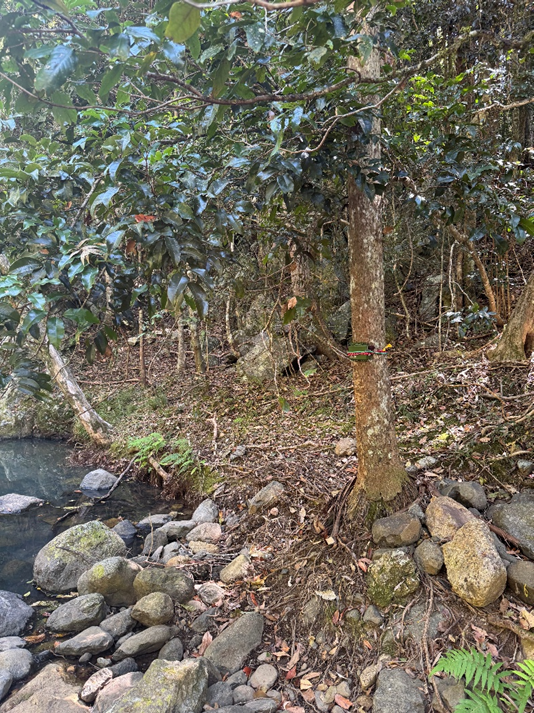
Recordings were collected between October and December, which corresponds with the peak breeding season for M. fleayi. Loggers were placed in candidate breeding habitats, particularly fast-flowing creeks where the species is known to breed. However, this created an unexpected technical challenge. Flowing water produces continuous low-frequency noise, and early analysis showed that this background sound could mask frog calls in spectrograms, making detections more difficult than anticipated.
Accessing the deployment sites required significant physical effort. While the area is publicly accessible, it involves multiple creek crossings, extensive walking, and frequent immersion in water. The landscape includes pockets of rainforest and dense vegetation, offering a very different experience from the dry eucalypt forests many students were familiar with. For some international students, this was their first experience in such an environment. Despite the challenges, the field trip was widely regarded as a highlight of the program and a formative learning experience.
In total, the project has so far involved five to six rangers, over fifty university students, and multiple teaching staff. The collaborative nature of the work was central to its success, with students learning about Country directly from rangers while learning technical skills in wildlife monitoring.
Findings
After the first year of sampling, the threatened frog species was not detected. Importantly, this outcome was not viewed as a failure. Instead, it provided valuable information about detection limits and survey design in challenging acoustic environments.
Unexpectedly, the recordings did capture calls from another frog species that is not listed as threatened but was considered uncommon in the sampled area. This discovery was particularly exciting for the ranger group, who were previously unaware that this species was present and calling within the area.
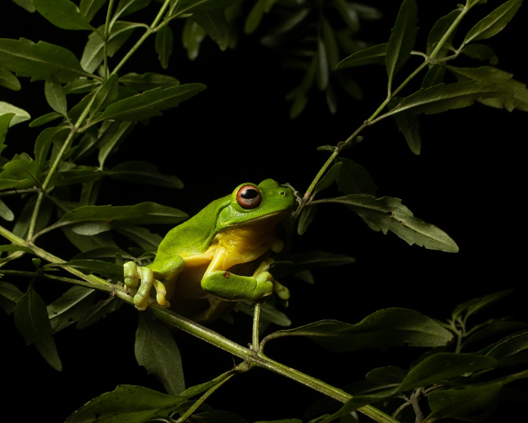 Litoria chloris (red-eyed tree frog). Pic: Coen Hird
|
To better understand the impact of background noise on detection probability, a separate undergraduate research project was conducted alongside the monitoring program. Using the same acoustic loggers, researchers played frog calls from mobile phones at varying distances in both noisy creek environments and quieter sites. This allowed the team to model how detection confidence changes with distance and background noise, providing a clearer understanding of how many loggers would be required to adequately survey entire creek systems. The validation work proved highly successful and has directly informed future monitoring design.
Measuring Success
Success for the project has been measured in several ways. Student learning outcomes were evident through assessments, exams, and reflective writing, with many students highlighting the value of working alongside Aboriginal rangers and engaging with Indigenous land management for the first time.
From a conservation perspective, the monitoring data improved understanding of species presence, absence, and detectability, reinforcing that non-detections still contribute meaningful ecological knowledge. The associated research strengthened confidence in bioacoustic methods and highlighted the importance of pilot studies.
Key Lessons and Moving Forward
Looking ahead, the project will continue during the same October to December period in 2026 and 2027, creating comparable datasets across years. Sampling effort is expected to increase now that the pilot phase has clarified detection challenges. All acoustic data remain fully accessible to the ranger group, who can use the recordings for ongoing analysis of frogs, birds, and other vocal species.
Beyond scientific monitoring, the recordings have also taken on cultural significance.
Some rangers have expressed interest in using the recordings for sound therapy and for dubbing videos of GIPAs natural beauty, pairing natural soundscapes with cultural elements. Hearing and sharing the sounds of their own Country has become an important outcome of the project in its own right.
For others interested in undertaking similar work, the key lesson is to begin with collaboration rather than permission. Projects are more successful when they are built around the priorities of Aboriginal ranger groups and Traditional Owners, rather than imposed from outside. In this case, bioacoustics was not the starting point of the research, but a response to a locally identified need to monitor a difficult-to-survey frog species in remote creek habitats.
Reflecting on the process, the team would now place greater emphasis on validation testing before large-scale deployment. The initial pilot study proved invaluable, and future projects will include early experiments to test detectability and reduce environmental interference, such as improving microphone protection in noisy or windy conditions.
This project used the Song Meter Mini 2 as its bioacoustics partner. To find out if it's the right fit for your next project, speak to us.
In the spirit of reconciliation, Faunatech acknowledges the Traditional Custodians of Country throughout Australia and their connections to land, sea and community. We pay our respect to Elders past and present and extend that respect to all Aboriginal and Torres Strait Islander peoples today.
Join our mailing list to get notified about upcoming training opportunities, live webinars, quarterly grant offerings, product releases, and more.
Thank you for signing up to our mailing list.
You can unsubscribe or change your email settings at any time by clicking "Manage Preferences" link at the bottom of any mailing list emails we send you.
